Cloud Computing Services: The Foundation of Digital Transformation
Transforming digitally is becoming a major objective for many companies in every industry. As an example, a healthcare company can improve their service to their patients by using digital technologies; a retail company can provide better experiences for their customers through digital offerings; and a manufacturing company can create efficiencies in their operation through the use of these technologies to be more profitable. The most prominent and transformational technology for facilitating the digital transformation of companies is the availability of cloud computing service providers.
Cloud computing evolution has shifted from just being a way to store your data online to a completely integrated platform for the consumption of your computing hardware, software, storage capacity, analytics, and artificial intelligence. Digital transformation efforts around the world have benefited from the flexible, scalable nature of the cloud as a means to realize the potential of digital transformation.
A Quick Overview of Cloud Computing Services
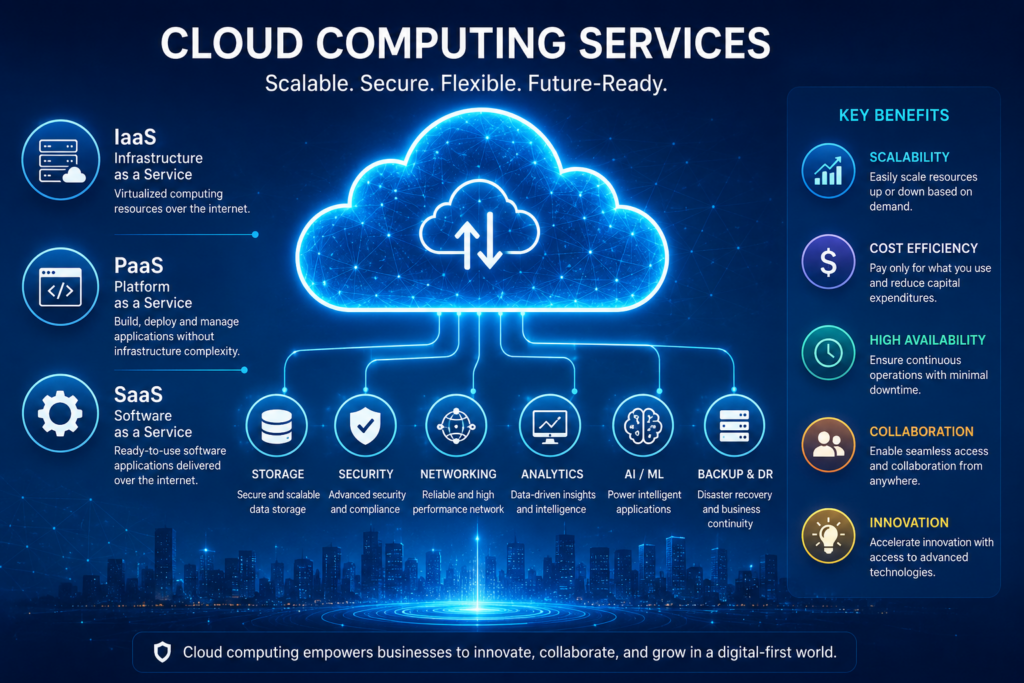
Cloud computing services are the delivery of computer resources provided through the internet instead of relying on local machines and servers. They can be infrastructure, platforms, software applications, databases, network, and storage solutions.
Cloud computing services enable an organization to access resources as needed and only pay for what they use. This allows an organization to avoid large up-front capital costs associated with assets like hardware or the maintenance complexity of operating large on-premises data centers.
There are three primary ways to deliver services:
- IaaS (Infrastructure-as-a-Service)
- PaaS (Platform-as-a-Service)
- SaaS (Software-as-a-Service)
Most important all business companies need to buy the kind of service where all they have for convenience to operate it how they will to run their business.
Accelerating Business Agility through Cloud Computing
An important part of digital transformation is the ability to be agile. Cloud Computing has greatly contributed towards this aspect when compared to traditional IT environments that use physical hardware for deployment of new infrastructure which can take weeks or months at a time. The time it takes to provision computing resources in a Cloud Platform is minutes.
For example, if a company that provides Digital Products needs to grow from providing services for 100 users up to providing the same service for 100,000 users, this can be accomplished without having to purchase any additional physical hardware. This fast response time to changing business requirements allows businesses to grow at a quicker rate, thereby allowing businesses to innovate quicker and respond to their customer’s needs based upon market demands.
Cloud Computing promotes innovation by enabling each team member to have the opportunity to test a new concept by executing a proof-of-concept and measuring results before making an extensive investment (either financing or resources).
As reported by Data Intelo, the global cloud service market will grow from its 2025 valuation of $736.4 billion to $2,482.6 by 2034. The overall growth rate (CAGR) of the cloud services will be 14.5% from 2026-2034.
Enhancing Accessibility and Collaboration of Data
Large organizations create vast amounts of data on a daily basis. The ability to store, organize, and access data via cloud-based computing allows individuals to access their data from virtually any location.
Those who work at different locations, whether in the same office, different cities, or different countries are able to utilize cloud-based applications and storage to work together on projects. All types of data associated with the company in, e.g., project files, customer records, and analytical dashboards, can be accessed in real-time.
If a company had employees in 15 countries (distributed around the world), they could use collaborative platforms based on cloud technology to collaborate on the same project simultaneously, enabling faster completion of that project and therefore greater productivity.
As the world transitions to more remote/hybrid workplace environments, the goal of creating a tighter group of connected employees has become more needed than ever before.
Assisting Scalability and Growth
The needs of a business do not often stay the same. The number of resources required will vary widely based on things such as it being the holiday season, launching a new product, or having an unexpected opportunity in the marketplace.
Cloud computing provides a Resource-Sensitive Infrastructure that is able to scale to meet the current need of the business. Rather than committing to hardware that can handle peak usage year ’round, businesses can adjust the number of resources they are using to meet the current levels of demand.
An example would be a business that begins to experience a growth in traffic due to the holiday shopping season (normally 300%). A cloud environment can easily accommodate that spike, while still maintaining the customer experience. Once the demand returns back to normal levels, the retailer can scale back the number of resources they use to maintain their efficiency for operations.
Read: Leading Generative AI System Integrators Driving Innovation
Establishing Better Business Continuity and Resiliency
Organizations can see their Quarters `perform their Q4 and how operations are significantly impacted by an unexpected incident. Events such as natural disasters; hardware failure (e.g., Motherboards); cyber incidents (e.g., Ransomware, Data Breaches); and power failure have the potential to substantially impede.
Cloud Providers Play a Major Role in Improving the Resilience of Organizations by Providing Distributed Infrastructure and Automated Backup Solutions that are Scalable. Due to the use of Cloud Services being able to replicate Data across Multiple (Geographically Separated) Locations Reduces the Possibility of a Single Point of Failure.
Many Cloud Providers Provide Business Recovery Solutions That Help Businesses Restore Time-To-Service Using Their Data at the Fastest Possible Way. As Businesses are Constantly Increasing Their Usage of Digital Means to Conduct Business Activities Throughout Their Daily Routines, the Significance of Recovering Critical Business Processes Has Increased.
Promoting New Ideas with New Tools
Cloud Computing is the basis for many of today’s new tools that are changing the way we do things and will change the way we do things over time. Most of today’s new tools such as AI (Artificial Intelligence), ML (Machine Learning), IoT (Internet of Things), Blockchain, and Advanced Analytic Tool Sets, depend on the Cloud to deliver the processing power and storage needed to run all of the required applications.
Smart City Projects have an immense amount of Data coming from 50,000 devices that are connected to create a City’s Transportation System, Utility System and Public Service System. Without the use of Cloud-based resources, it would be almost impossible to handle this amount of data that is produced- and then to analyse it!
The same is true for Healthcare Organizations. They are using the Cloud to process Medical Images, support and deliver Telemedicine Services and expedite Research Programs.
Addressing Security and Compliance Issues
The security of digital transformation is critical. There are new challenges associated with adopting and using the cloud, but many organizations can leverage sophisticated security tools as part of their overall cybersecurity strategy; otherwise, they would struggle to implement them on their own.
Today’s cloud environments can provide encryption, identity management, threat detection, access controls, and continuous monitoring. Organizations can also leverage compliance frameworks developed specifically to help organizations meet regulatory compliance.
Still, continued governance over effective security, continual awareness for employees for the ongoing management of risk, and, therefore, will lead an organization’s information systems (especially cloud technology) to be individually viewed as part of the organization’s entire cybersecurity program.
Final Thoughts
Cloud-based solutions have developed into more than just a technological fad. They are a critical driver of new digital transformations and provide organisations with the necessary flexibility, scalability, accessibility and capability to innovate that today’s businesses require. Through collaboration and remote work based on cloud computing, combined with advanced analytics and resilience for better adaptation, cloud computing supports organisations as they continue to work towards becoming digital.
As technology evolves and the world changes, cloud computing services will continue to be an integral part of transformation efforts by assisting organisations with their journey through change, providing organisations with new opportunities and continuing to enhance operational efficiencies across global supply chains.