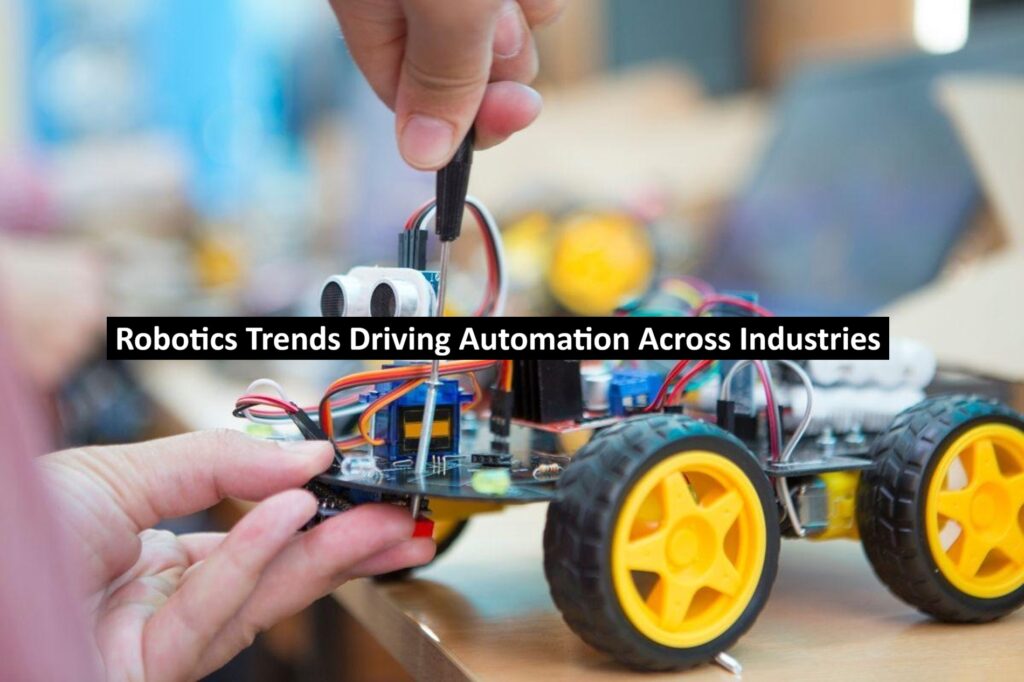
Robotics Trends Driving Automation Across Industries
With automation, businesses are able to automate mundane tasks and cut down the errors made by humans to gain efficiency. Robotics, due to advancements made by artificial intelligence, machine vision, sensors, and automation software; robot can be applied effectively not only in the manufacturing sector but also other sectors such as health, logistics, agriculture, retail, construction.
Increasing adoption of robotics is also impacting how companies view productivity and manpower management. Instead of every human job being replaced, many contemporary robotic systems work side-by-side with workers, performing monotonous and/or physically taxing tasks and freeing up workers for higher-level tasks.
AI-Powered Robotics
AI is one of the most significant forces driving the development of robotics. AI allows robots to understand their environment through input processing, object recognition, as well as to make decisions in response to a continuously changing environment.
Moreover, machine learning can enable robots to adapt over time in terms of performance enhancement, especially in unpredictable environments in which tasks are inconsistent and robots are required to react rather than to perform the same sequence of motions.
Collaborative Robots
A cobot or a cooperative robot, is a robot which is collaboratively intended for direct interaction and working together with workers or co-operators. While robots normally operate individually or are programmed in safe cages as a result of safety worries, cobots are able to assist employees in various tasks like production, packaging, sorting, or materials management processes.
They allow flexibility for a wide range of automation to be implemented without having to reconfigure a full production space and can suit even smaller companies, since most of these systems are reprogrammable.
Robotics in Manufacturing
Of course, some sectors have embraced robotics far more than others. One of the most roboticised sectors by far is the one you perhaps already predicted – manufacturing robots. Automated machines help with welding, assembly, painting, quality control, as well as handling.
Smart factory technologies mesh together robots with data sharing industrial sensors and analytics, machine and device communication and industrial software in a closed loop fashion. That’s because with such a system manufacturers should get: access to status information on machines, indication about problematic processes, real-time feedback from production.
Robotics Adoption: Largest Industry While much work remains, in the areas of manufacturing robotics has made some serious inroads. Robots weld, paint, inspect for quality and do assembly work just as they do in manufacturing. As factories become increasingly connected, businesses are also adopting network automation to build smarter enterprise infrastructure, helping manage connected systems, improve scalability, and reduce manual processes. Combining robots with wired and wireless sensors, industrial software applications, and real-time data analytics equipment are monitoring manufacturing systems and enabling managers to troubleshoot process issues, detect machine breakdowns and improve processes.
Automation in Logistics and Warehousing
Increased demand for warehouse efficiency “With ever-increasing growth of e-commerce, the need for warehousing processes that are even quicker and smarter only intensifies. AMRs, which are capable of moving products or materials while aiding in order fulfillment, were a common topic”.
Mobile robots work with staff members to minimize walking and also increase productivity. Automated picking and sorting technologies assist the business cope with volume-associated pressures for logistics providers.
Robotics in Healthcare
Robotic solutions create similar opportunities within another industry. Robots find an application in healthcare to help assist during surgeries, rehabilitation, delivering medications,disinfecting equipment or rooms as well as laboratory equipment and procedures.
For some medical applications, robotic systems can offer high precision and repeatability. With technological improvements being made, organizations are beginning to find other suitable uses for robotics while still having the necessary human supervision.
Agricultural Robotics
The agriculture industry is using robots in an attempt to ease their labor shortage and increase the output of their operations. Robots are proving very useful in seeding, harvesting and crops being monitored and identified for weed existence, as well as other agricultural processes.
Integrated together with robots and smart computers, this would aid in making targeted responses to each plant and condition of the land using just real-time field conditions that the robots will capture with its built-in sensors, optimizing irrigation and the use of fertilizers and various other useful assets.
Autonomous Robots
Thanks to robots that can see, reason and make decisions like a person would, robots that need human help operate with human intervention become less. Technologies like improved navigation systems and advanced AI enable robots to get a grasp on the situation without needing human guidance; therefore their efficiency grows when a robot doesn’t need to listen to human instructions.
Automated mobile robots would be especially applicable to warehousing, manufacturing plants, hospitals, and large business centers. Using their autonomous navigation capability would eliminate the need for constant operator control.
Robotics and Human-Machine Collaboration
Humans and robots work more intimately as the automation trends take into account this co-exist as we discussed above. The robots should perform repetitive tasks, dangerous ones and physical activities while humans bring decision making capabilities, creativity, problem solving and communication.
This can be beneficial as productivity increases, yet it does not eliminate the need for the human element in many areas. Employees will likely be trained in new technical skills; required to operate, monitor, and maintain sophisticated automated systems.
Future of Robotics Automation
What is coming? New technologies like AI, smart sensors, connectivity through the cloud, computer vision, and machine autonomous decision-making capabilities will likely be combined to equip the next generation of robotic machines. Robots in the future won’t just do one thing well, but should become more adept and versatile doing more jobs in more locations.
With increasing technology affordably and accessibility, it’s a realistic option that small and mid-sized enterprises can adopt robotics increasingly. Companies which can mix Automation using talent, data protection, and sensible technology administration will have better chances for achievement through subsequent’industrial evolution phase.
Author’s Bio:
Lalit is a freelance content writer, blogger, and digital marketer with 6 years of experience. He writes clear, engaging content on the robotics market, SEO, technology, business, education, and market trends, making complex topics easy to understand and apply.