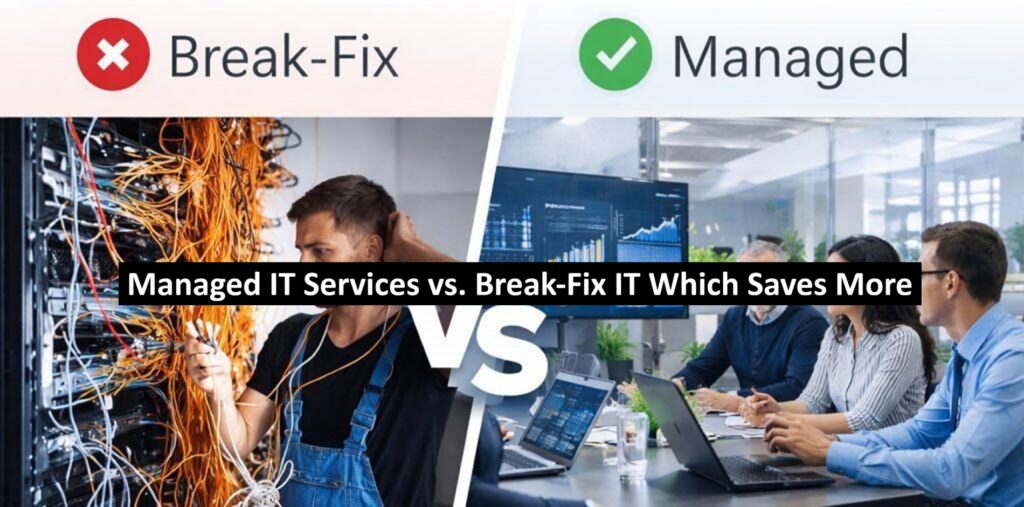
Managed IT Services vs. Break-Fix IT: Which Saves More?
Technology has evolved as a growth engine for global companies. Unfortunately, this engine stutters sometimes, pausing every connected operation and workflow. Big companies make a shift easily by affording expensive IT support services. But this situation becomes a nightmare for SMEs, or small to medium enterprises, because they manage everything on a tight budget. Many of them are not sure about what technology to use to overcome a technical glitch, or how to professionally support in-house teams.
The question is, “Should you wait for things to get worse?” or “Should you call for help from a professional to keep things aligned with the business objective 24/7?” Certainly, the break-fix option seems affordable, but over time, it costs a lot.
Let’s explain both cases with their definitions below
Understanding the Two Models
Let’s explain these two widely popular models.
- The Break-Fix Approach
Wikipedia describes this approach as a reactive service model, meaning the IT support experts will repair, maintain, and provide technical support only when a system, device, or tech component breaks down or malfunctions. This case is subscription-free, meaning you only pay for the fixing, and the labor required to fix that technical glitch when it occurs.
Let’s say a small-scale business notices a system has crashed; its server goes down often, and even its corporate emails stop syncing. To resolve these glitches, the IT head of the company calls a technician to fix the problem at a cost.
Initially, the business finds this cost okay to pay. But the server breakdown continues twice a month. The cost, which was bearable initially, seems to be mounting because of frequent server downtimes. So, you must pay every time you call a professional IT engineer to address tech glitches.
- Managed IT Services: “Prevention is better than Cure”
Managed IT services represent a tech transformation from legacy systems to a proactive partnership. Hiring an expert managed service provider with hands-on experience is a worthy decision because it helps with everything from security patches, routine updates, and data backups to workflow optimization, before problems even exist. For sure, it requires you to pay a flat monthly fee, but you get peace of mind in return.
Read: AI Call Centre Technology: Turning Voice into Intelligence
The True Cost: Why “Cheaper” Isn’t Always Better
The idea of paying “zero monthly fees” tempts many entrepreneurs and global businesses. But reality differs. It ignores the hidden costs of reactive IT.
- The Cost of Downtime: If you think that the most significant expense in the break-fix approach is paying for the repairs, think twice. It also covers the cost of lost productivity and revenue while the repair is ongoing. Due to technical challenges and long IT downtime, businesses suffer thousands of dollars every minute. Furthermore, the loss of output and missed opportunities is an add-on.
- The “Uncertainty” Rules: The break-fix approach does not mandatorily require you to secure funds, as happens in the case of a subscribed service. Certainly, you pay only when there are any patches required. But tech disasters like ransomware may not be visible at the point of entry. When they escalate, everyone hears the noise. It may cost thousands of dollars after months of paying “zero repair costs”.
- The “Immediate” Care: A technical glitch instantly needs someone to attend to it seriously. When you call a technician when your server is down or your software has crashed, he quickly fixes the problem to get your server or software back to life. It is not necessary that the expert is looking at the big picture or the gaps in the infrastructure. When the root cause is not addressed, the same problem is likely to return, attracting more expenses.
The Power of Managed IT Services for SMEs

Managed IT services are the opposite of break-fix. Though they require a flat fee, the service keeps your IT assets perfectly aligned and optimized to achieve long-term goals. Every hour spent proactively managing technical things and assets prevents the occurrence of a major technical glitch in the future.
Key Benefits for Your Bottom Line:
Here are some key advantages of these proactive business IT support for SMEs:
- Predictable Budgeting: You stay informed about how much money to spend on IT every month. This practice proves cost-effective, as they secure funds more effectively to achieve growth and innovation.
- Access to Expertise: Outsourced cost-effective IT solutions introduce you to an entire team of tech experts who manage cybersecurity, cloud, and networks of an IT infrastructure at a fraction of the cost of hiring just one full-time in-house IT employee.
- Proactive Security: With cyber threats becoming more common and more sophisticated, a basic antivirus won’t provide proactive protection. MSPs run 24/7 monitoring, vulnerability assessments, and rapid incident response. These solutions protect a brand’s reputation and proprietary data.
- Data Maturity and AI-Readiness: Modern and upskilled MSPs are mature enough to manage clean and structured data. Smart AI tools understand the voice of data, which helps them predict gaps and streamline back-office operations rapidly.
The Numbers Speak for Themselves
If you think the aforementioned points are hypothetical, explore the research from CompTIA. It says over 80% of companies have taken a leap from the break-fix model to a managed service model. For sure, this switch has saved millions of dollars for those who embraced this trend. Additionally, 13% of those businesses are actually accumulating 50% more savings on their IT expenditure.
Conclusion
You may call it the verdict, which favors managed services. It is simply because sending emails, processing transactions, or managing customer data are routine exercises. A small glitch or phishing bot in an email won’t be noticed until your inbox gets blocked. So, a break-fix model may feel like an affordable option to pay for repair services only. But over time, the repeated tech troubles drain your budget.
Therefore, the transition to managed IT services isn’t just technical support; it covers everything from repair costs to proactive IT asset monitoring. This service ensures business continuity, and your dedicated technology partner contributes to your growth, business stability, and long-term success. So, the next time you think of a prosperous, smart growth plan for your business, focus on proactive IT services. With this solution, you can easily analyze current IT pain points while discussing how a managed approach can help your business thrive.